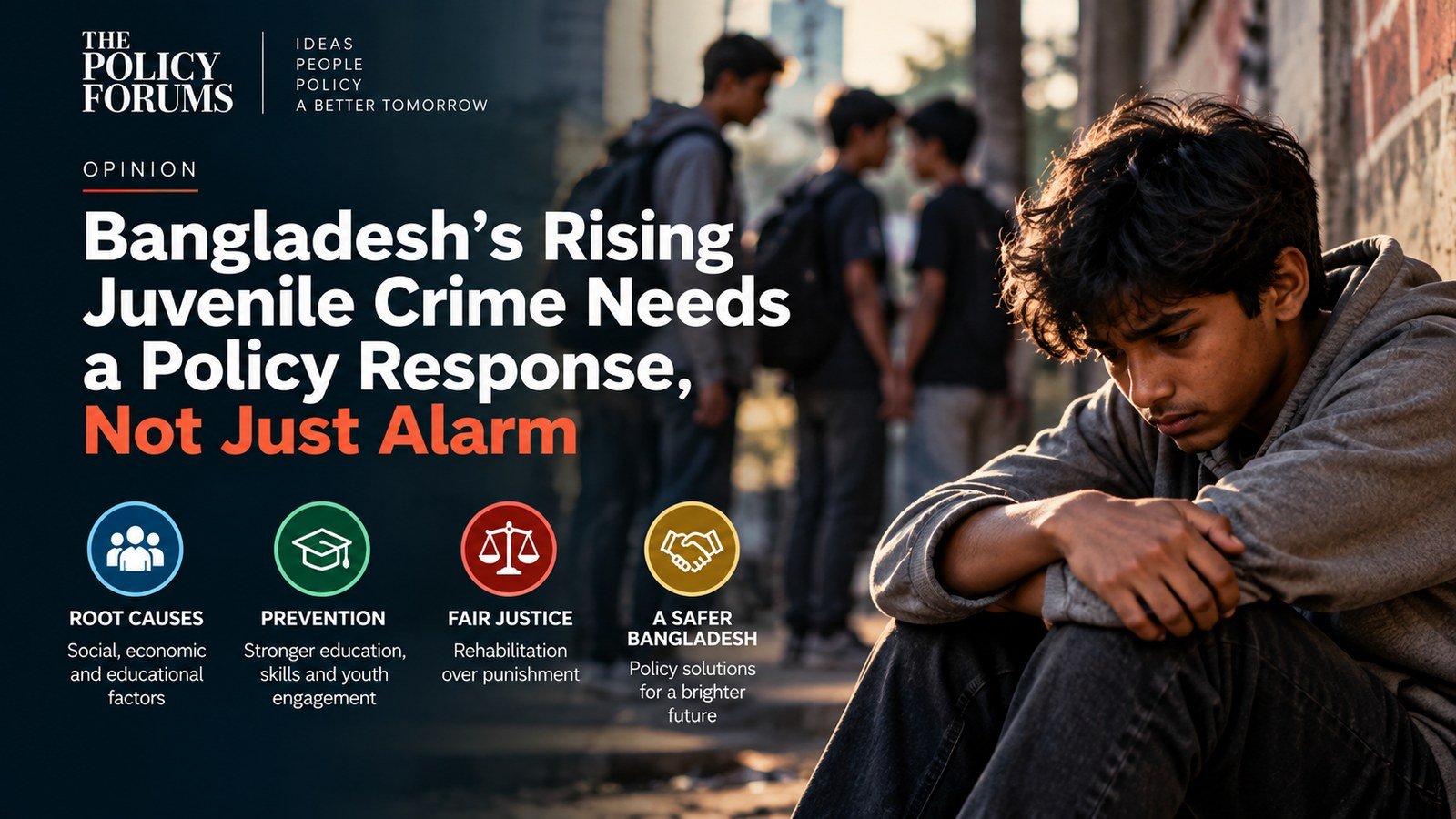
The murder of 13-year-old Ishayat Shahriar Apratim in Cumilla has reignited public alarm over youth violence in Bangladesh — but alarm alone won’t fix what’s driving it.
What the evidence shows: Sociologist A I Mahbub Uddin Ahmed points to family and social breakdown — single-parent households, divorce, and absent parents — as creating vulnerability to gang involvement. Psychiatrist Dr Helal Uddin Ahmed adds a newer dimension: social media platforms that reward aggressive, “cool” behavior with likes and followers, pushing some young people to perform violence for an audience. Layered on top are older, structural drivers: poverty, unemployment, school dropout, child labor, and child marriage.
Counterargument: Some argue that focusing on social media and family structure risks distracting from more fundamental economic drivers — that if youth unemployment and school dropout rates were addressed, the social and digital pressures would carry far less weight, since idle, economically insecure young people are the ones most susceptible to both gang recruitment and performative online violence.
Policy implication: Bangladesh’s institutional response to youth violence still leans heavily on punishment after the fact rather than identification and intervention before it. Schools largely lack systematic mechanisms to flag bullying or escalating aggression early, and rehabilitation frameworks for young offenders remain underdeveloped relative to punitive ones.
My take: A credible response has to work on both tracks at once — economic and institutional. Addressing school dropout, child labor, and child marriage attacks the structural drivers directly, while building early-identification systems in schools and expanding rehabilitation over pure punishment addresses the immediate behavioral crisis. Treating this purely as a law-and-order problem, or purely as a parenting problem, misses that both structural and social dimensions are operating together.
Confidence level: Moderate. The causal factors described are well-supported by expert commentary in the source reporting, but the article itself does not provide crime statistics to quantify how much juvenile crime has actually risen.
Related reading: What is driving Bangladesh’s rising juvenile crime? — The Business Standard