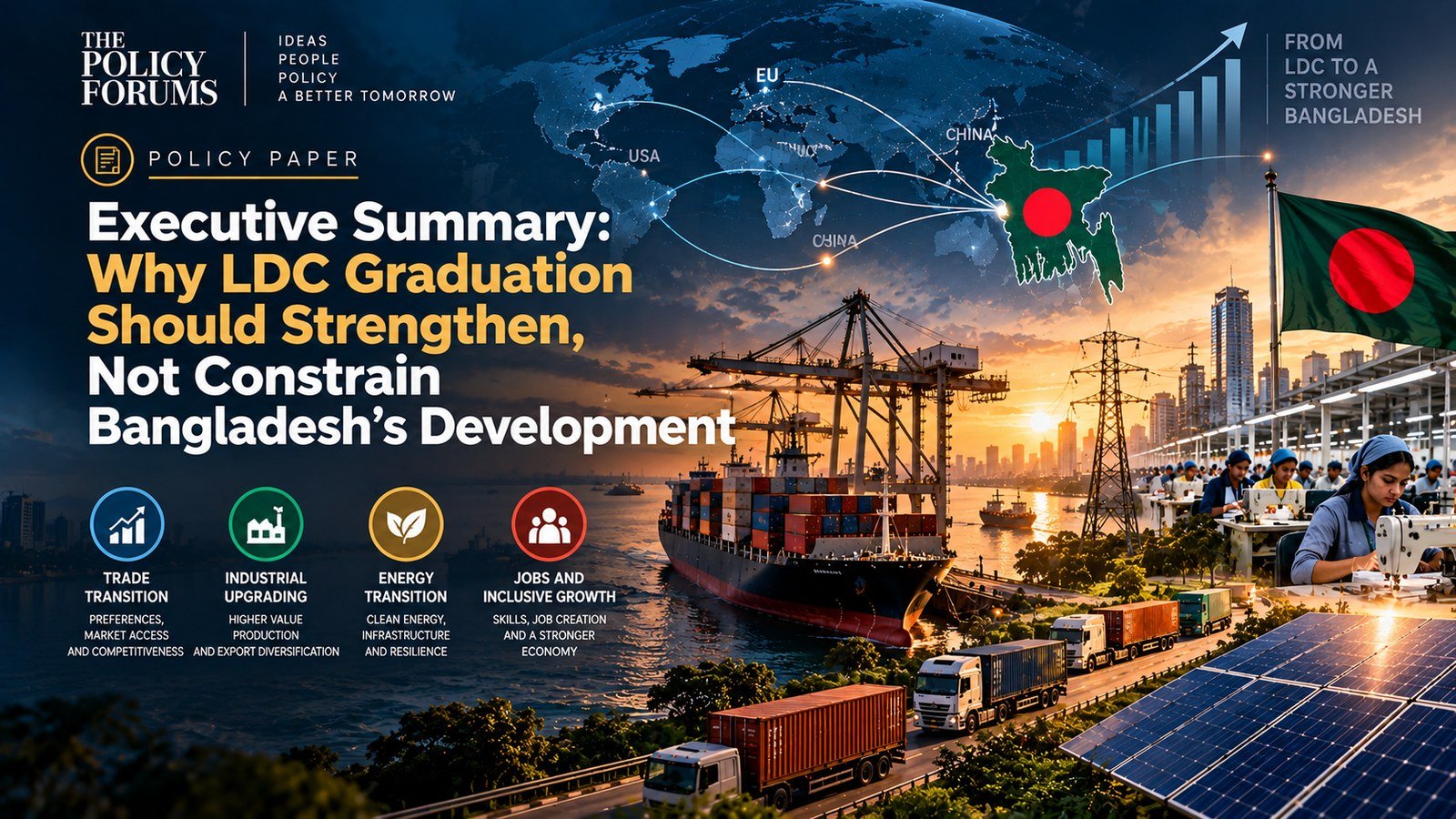
The paper’s core question: As Bangladesh moves through Least Developed Country (LDC) graduation, how can the transition avoid becoming a constraint on development rather than a milestone within it? Dr Rashed Al Mahmud Titumir, the Prime Minister’s Adviser on Finance and Planning, addressed this directly in remarks reported by The Business Standard.
Key findings: Titumir draws a distinction between simple graduation and “sustainable graduation” — arguing the two are different outcomes. Graduating LDCs continue to face limited productive capacity and structural economic barriers even after graduation, compounded by external pressures: geopolitical conflict, supply-chain disruption, trade uncertainty, and inflation. He notes that “actual technology transfer remains modest compared with their needs,” pointing to a gap between what developed-country support commitments promise and what materializes.
Counterargument: Graduation advocates argue that LDC status itself, if prolonged indefinitely, can create disincentives for reform and investment — meaning graduation should be treated as a forcing function for competitiveness rather than something to be softened or delayed.
Policy implication: The debate isn’t graduation versus no graduation — Bangladesh’s graduation is proceeding regardless — but rather what sequencing and support structures accompany it. Titumir’s framing suggests graduation timing without matching industrial, energy, and job-creation transitions risks trading a preferential-trade status for a harder competitive environment without the domestic capacity to compete in it.
Recommendation: Titumir points to the LDC Green Industrialization Facilitation mechanism as a potential vehicle for advancing sustainable graduation — pairing trade transition support with industrial upgrading and energy transition investment, rather than treating graduation as a single trade-status event.
Confidence level: Moderate. The arguments and framing are directly attributed to a named senior government adviser, but the piece is more programmatic than data-driven, and doesn’t quantify the specific economic costs or benefits at stake.
Related reading: LDC graduation must strengthen, not constrain, development: Dr Titumir — The Business Standard