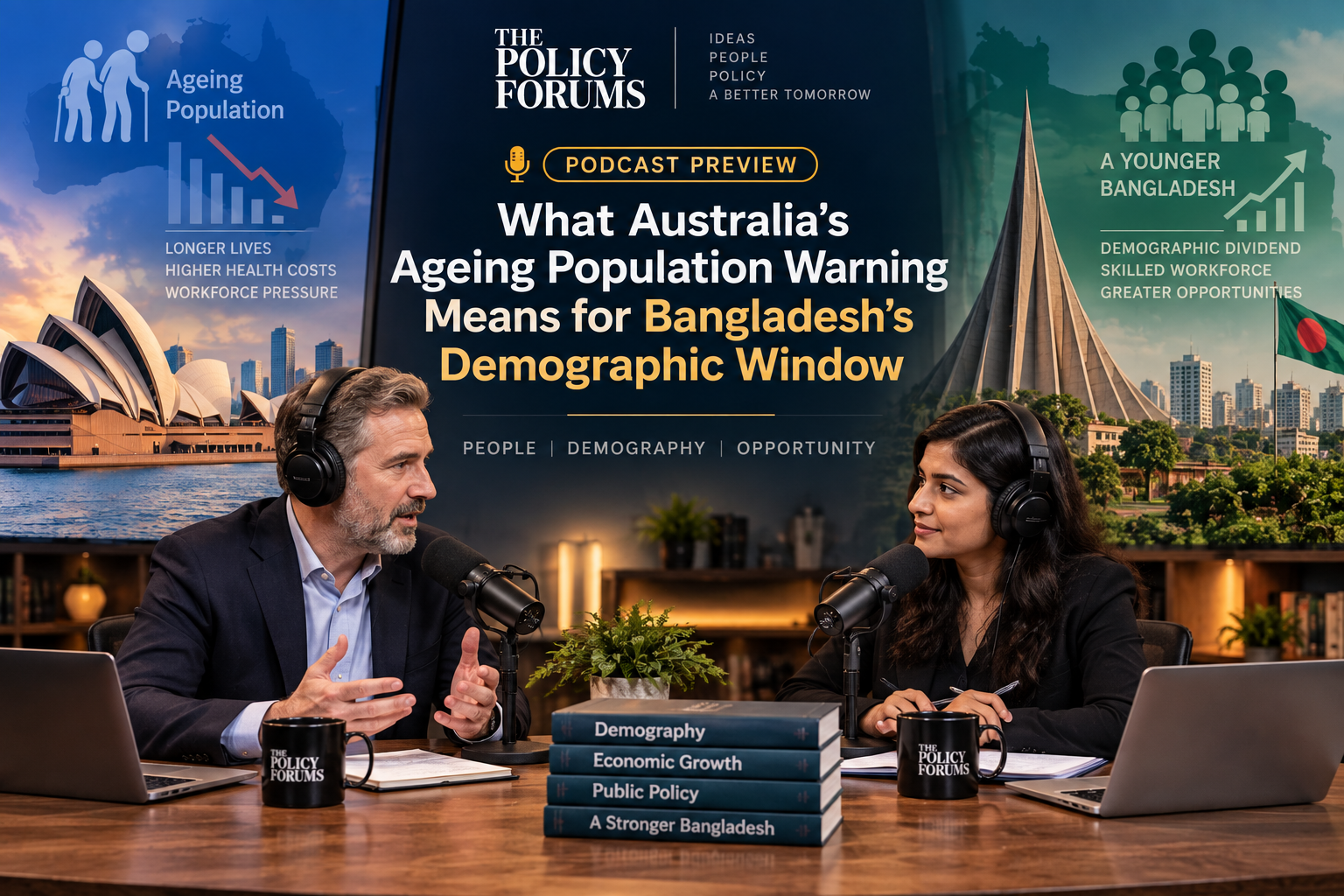
Australia’s Treasury projects population growth will slow to 0.9% annually over the next four decades, down from a 1.4% average over the past 40 years, with deaths projected to outnumber births by the 2060s for the first time in the country’s modern history — a milestone Treasurer Jim Chalmers has flagged, per reporting followed by The Business Standard. The number of Australians over 85 is expected to triple by 2066, straining a care system already reliant on migrant labour just as immigration policy tightens under political pressure.
Why a Bangladesh audience should care: Bangladesh is currently inside its own demographic dividend window — a period when the working-age share of the population is unusually large relative to dependents — but that window is not permanent. Countries that failed to convert a demographic dividend into productive employment and savings before their populations aged, as several East Asian economies successfully did and some Latin American economies arguably did not, offer a cautionary comparison.
Counterargument: Demographers caution against over-reading Australia’s trajectory onto Bangladesh’s, since Australia’s ageing challenge is driven by high living standards and low fertility among a wealthy population, while Bangladesh’s demographic transition is happening at a much lower income level with different fertility drivers — the two countries are decades apart on the transition curve.
Policy implication: Bangladesh has perhaps one to two decades left to convert its current working-age population bulge into productive employment, savings and pension infrastructure before the same ageing pressures Australia now faces begin to bind.
Recommendation: Accelerate contributory pension-scheme enrolment now, while the worker-to-dependent ratio is favourable, rather than waiting until the ageing transition is already underway and the fiscal room to build such a system has narrowed.
Confidence level: Moderate. The demographic-dividend framework is well-established economic theory; the specific timeline for Bangladesh depends on fertility and mortality projections that carry meaningful uncertainty.
Related reading: Australia warns of risks from ageing population, falling birth rates — The Business Standard