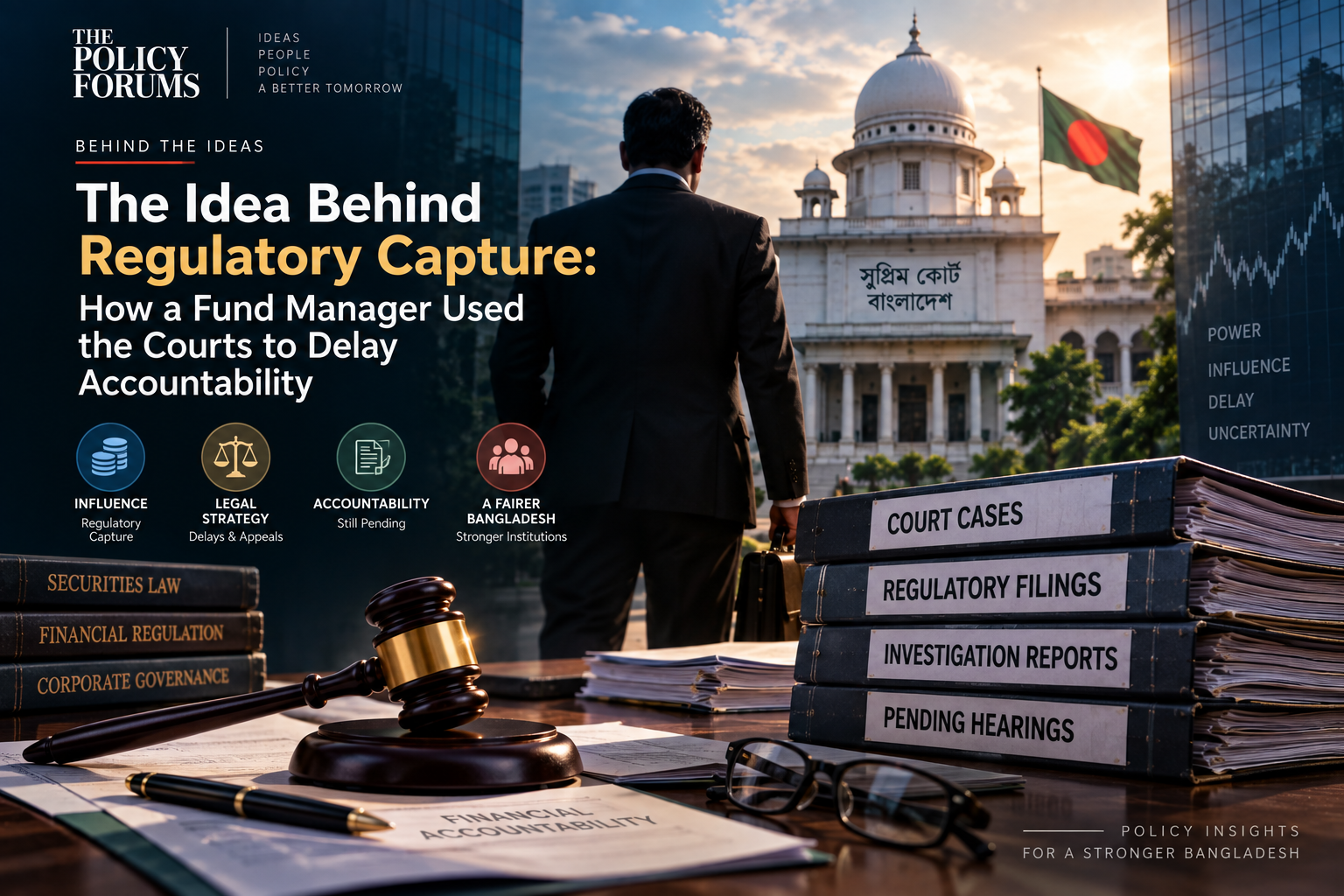
RACE Asset Management once managed 10 mutual funds worth roughly Tk3,500 crore, making it Bangladesh’s largest fund manager. Regulators later uncovered Tk1,613 crore in alleged money laundering, Tk180 crore in inflated net asset values across four funds, and Tk345 crore invested in violation of fund trust deeds, The Business Standard reported. Yet it took the Bangladesh Securities and Exchange Commission (BSEC) roughly 15 months of litigation — including a High Court stay obtained by RACE in February 2025 and around six separate cases against the regulator — before enforcement could proceed.
The idea worth dissecting: This is a textbook case of what economists call regulatory capture through litigation — not bribery or backroom influence, but the strategic use of courts, stay orders and procedural challenges to make enforcement so slow and costly that a regulator’s findings are effectively neutralised for years, even when the underlying violations are well-documented.
Counterargument: Access to judicial review is a legitimate due-process right, and not every legal challenge to a regulator is bad-faith obstruction; some safeguards against regulatory overreach genuinely require courts to intervene, and conflating litigation with capture risks undermining legitimate appeals.
Policy implication: When a regulator’s own investigative findings can be stayed for over a year through repeated litigation, the deterrent effect of regulation collapses — bad actors can calculate that even a well-proven violation is a manageable cost of doing business.
Recommendation: Bangladesh’s capital markets framework needs a statutory cap on how long a stay order against a completed regulatory investigation can remain in effect without substantive court review, plus interim asset-freezing powers that survive procedural challenges, similar to models used by securities regulators in India and Malaysia.
Confidence level: High on the facts of this case (drawn from investigative reporting and BSEC’s own record); moderate on how representative it is of capital-market enforcement more broadly, since this is one high-profile case rather than a systematic study.
Related reading: How RACE turns to legal tangles to stall enforcement, probe into irregularities — The Business Standard