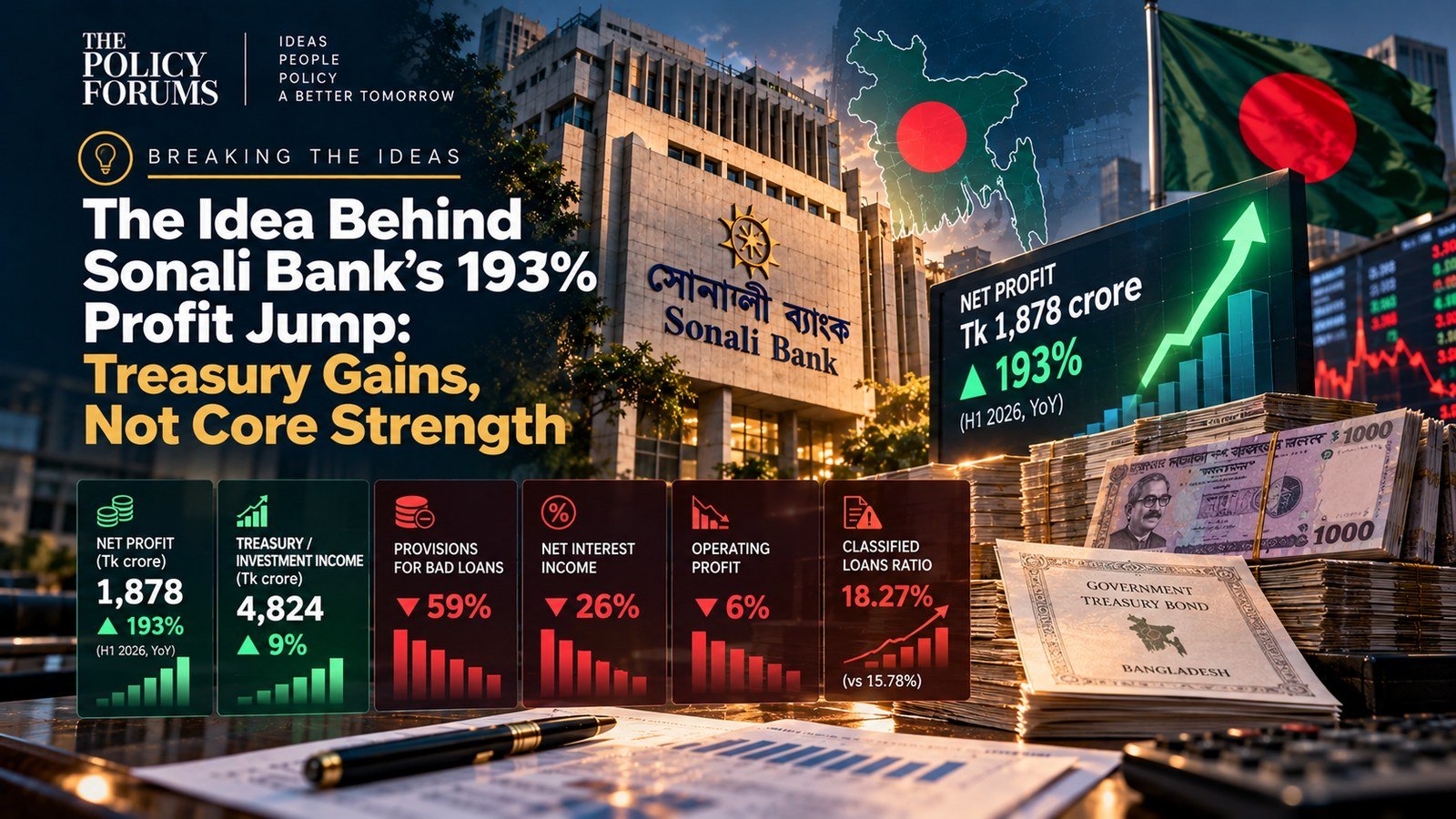
The claim: Sonali Bank reported a 193% year-on-year jump in consolidated net profit to Tk1,878 crore for the first half of 2026 — the highest six-month earnings of any local bank, The Business Standard reported.
The idea worth breaking down: A headline profit surge this large invites a simple reading: the state-owned bank is thriving. The underlying numbers tell a more complicated story. Investment (treasury) income rose 9% to Tk4,824 crore, and provisions set aside for bad loans fell 59% year-on-year — both of which mechanically inflate reported profit. Meanwhile, net interest income — the core measure of lending profitability — fell 26% due to elevated borrowing costs, and operating profit actually declined 6%.
Why this matters: Classified loans rose to 18.27% of total disbursement, up from 15.78% at the end of 2025 — a sign that loan quality is deteriorating even as reported profit rises. A profit figure driven by lower provisioning against a worsening loan book, rather than stronger lending performance, is a different kind of “good news” than the headline suggests.
Counterargument: Treasury income is a legitimate, recurring revenue stream for banks, not a one-off accounting trick, and lower provisioning can be justified if a bank’s risk models genuinely indicate reduced expected losses rather than reflecting political or accounting pressure to show a stronger bottom line.
Policy implication: Headline bank profit figures can mask asset-quality trends that matter more for financial stability. Regulators and the public benefit from disclosure standards that make the composition of profit — core lending versus treasury gains versus provisioning changes — as visible as the topline number.
Recommendation: Bangladesh Bank should continue pushing state-owned banks toward provisioning policies grounded in independently verified asset-quality assessments, and require clearer breakdowns of profit sources in quarterly disclosures so headline growth figures don’t obscure rising classified-loan ratios.
Confidence level: Moderate. The profit, income, and provisioning figures are drawn directly from reported financials; whether the provisioning reduction reflects genuine improved risk or discretionary softening is not something the source article resolves.
Related reading: Sonali Bank’s H1 profit jumps 193% to Tk1,878cr on treasury gains, lower provisions — The Business Standard