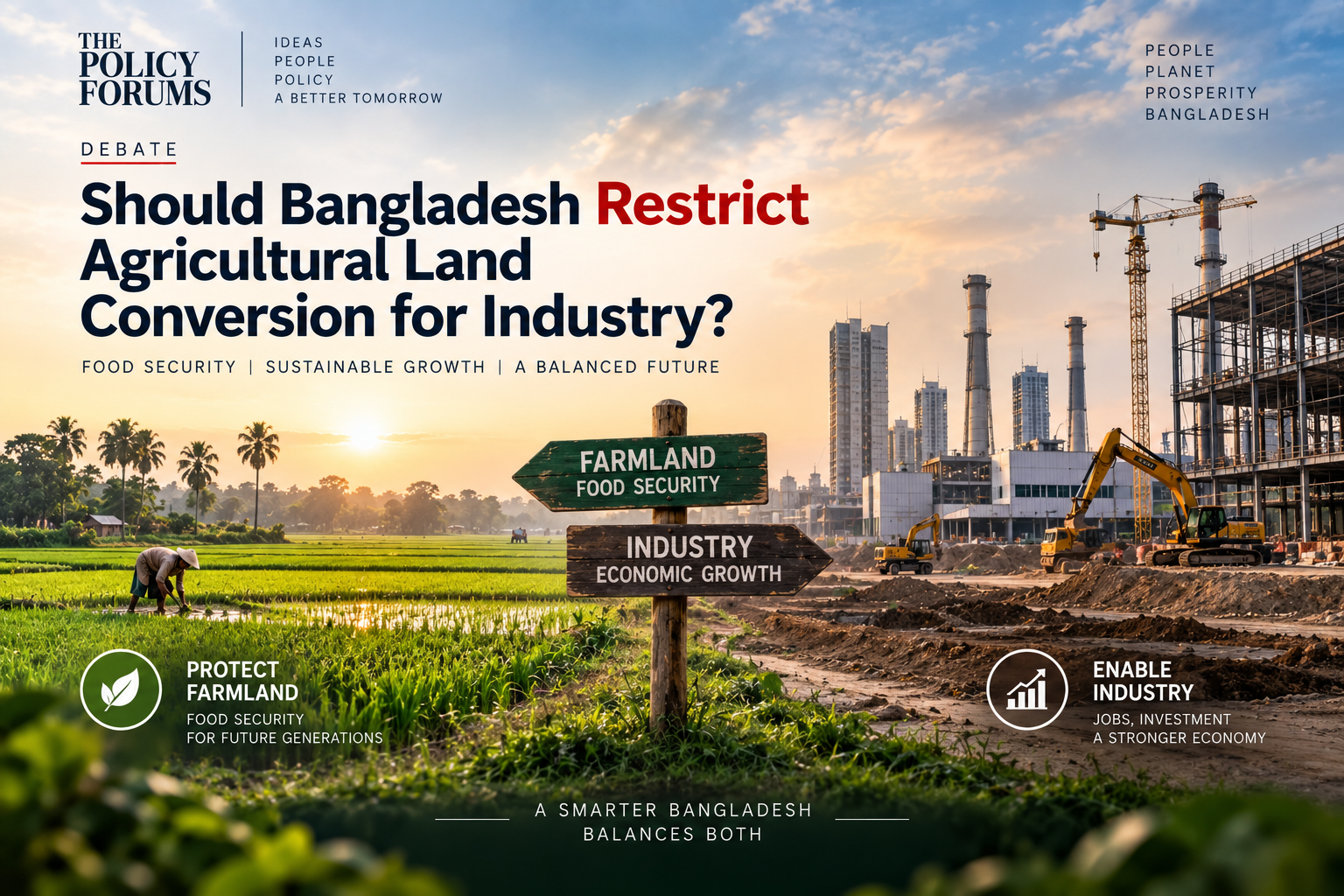
Bangladesh has one of the highest population densities per unit of arable land in the world, and multiple planning studies have warned that a meaningful share of farmland is converted to housing, roads and industry every year, though precise national figures vary by methodology and are contested. Whether to legally restrict that conversion is a live policy debate.
Point: restrict conversion
Proponents argue food security cannot be taken for granted in a country already dependent on imports for part of its grain and edible-oil needs, and that once farmland is built over it is effectively gone. They point to Rwanda’s national land-use consolidation policy, which designates protected agricultural zones and channels industrial and residential growth into non-agricultural land — a model credited with helping Rwanda raise cereal yields even as its population grew.
Counterpoint: let local needs decide
Opponents argue rigid land-use restriction in a country as densely populated and fast-urbanising as Bangladesh could constrain industrial job creation exactly where it is needed — near existing population centres and transport corridors — and that overriding landowners’ right to convert their own land for higher-value use without compensation is a heavy-handed remedy. They also note productivity gains from better seed varieties, irrigation and double-cropping have historically outpaced land loss in raising total farm output.
Where the evidence points: Rwanda’s experience shows zoning can work, but it was paired with heavy state investment in irrigation and extension services on the protected land — zoning alone, without that complementary investment, has a weaker track record elsewhere in the region.
Policy implication: A blanket restriction without investment in agricultural productivity on protected land risks freezing farmers into low-yield plots rather than genuinely protecting food security.
Recommendation: Designate protected agricultural zones around the highest-yield districts specifically, paired with irrigation and extension investment, while leaving conversion rules lighter-touch elsewhere — a targeted rather than nationwide restriction.
Confidence level: Low-to-moderate. National land-conversion statistics for Bangladesh vary significantly by source and methodology, which limits how precise any recommendation here can be; this should be read as a framework for debate rather than a fully costed policy.