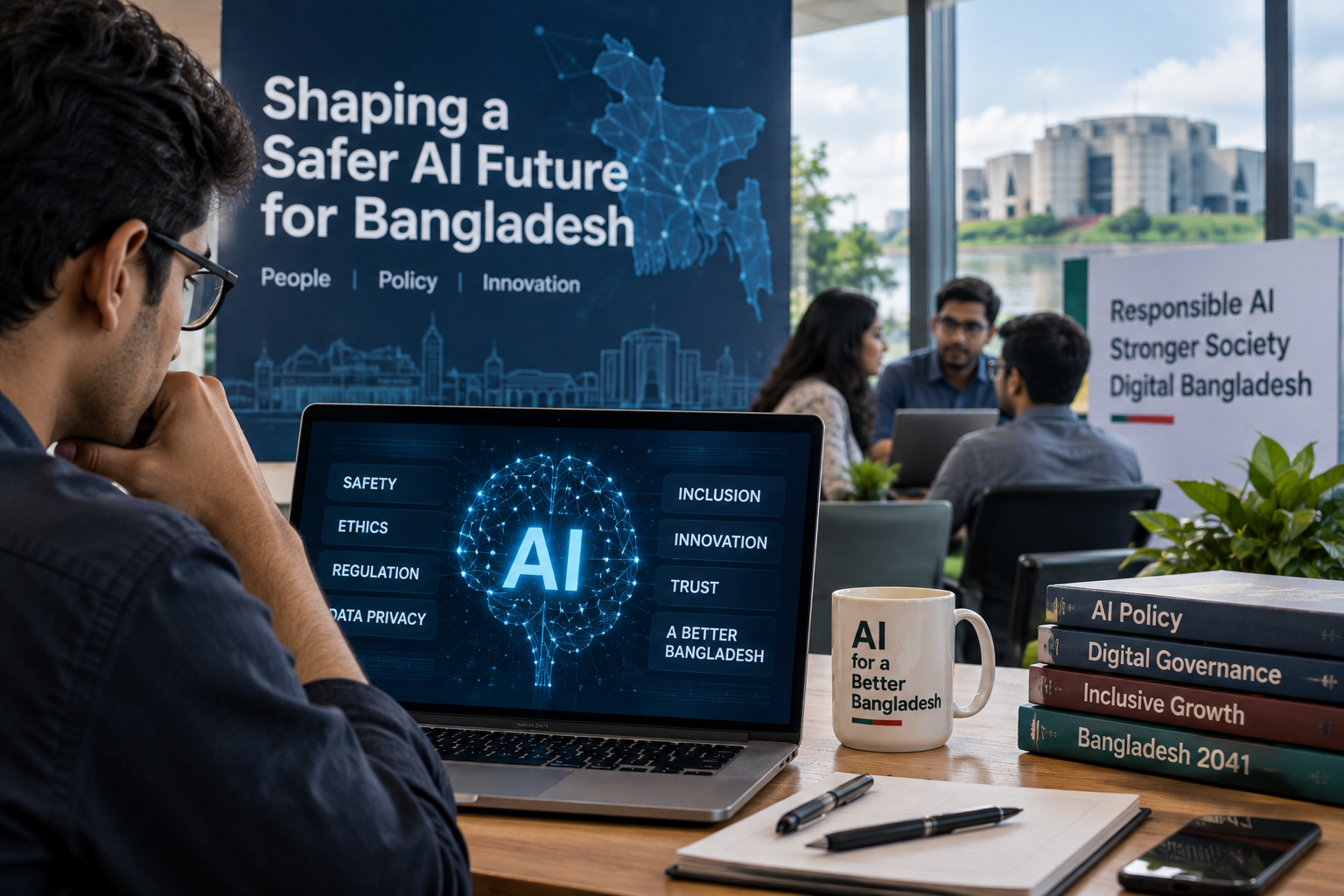
AI safety has moved from research-lab discussion to head-of-state diplomacy: OpenAI chief executive Sam Altman is expected to address AI safety at this year’s UN General Assembly, and Anthropic is reportedly weighing a new model release ahead of a possible IPO, according to reporting picked up by The Business Standard. For a country like Bangladesh that imports rather than develops frontier AI systems, the relevant question is not whether to join the AI race but how national policy should respond to a technology it does not control.
What the research says: The same IMF research on youth unemployment discussed elsewhere in this issue already flags automation and AI as displacing entry-level technical and administrative roles in Bangladesh’s labour market — a domestic consequence of a global technology shift, regardless of where the underlying models are built. Separately, international AI-safety research bodies have increasingly called for “AI readiness” frameworks in developing economies that cover three areas: data-protection law, workforce transition support, and government capacity to evaluate AI systems used in public services.
Counterargument: Some technology-policy analysts argue that developing countries have limited leverage over frontier AI governance set primarily in Washington, Brussels and Beijing, and that resources spent on domestic AI-safety frameworks would be better directed at basic digital infrastructure and connectivity gaps that remain unresolved.
Policy implication: Bangladesh does not need to regulate frontier AI development it has no part in, but it does need policy for AI’s downstream effects — on its labour market, on data privacy as AI tools are adopted by local firms, and on the integrity of public services if AI systems are procured for government use.
Recommendation: Prioritise a narrow, implementable digital policy agenda: a data-protection law with enforcement teeth, a labour-transition fund financed partly by a small levy on large-scale automation adopters, and a public-sector AI procurement standard requiring human review of any AI system used in citizen-facing decisions.
Confidence level: Moderate. The global AI-safety debate is well documented; how it will concretely affect Bangladesh’s labour market and policy needs is an extrapolation from adjacent evidence rather than Bangladesh-specific research.