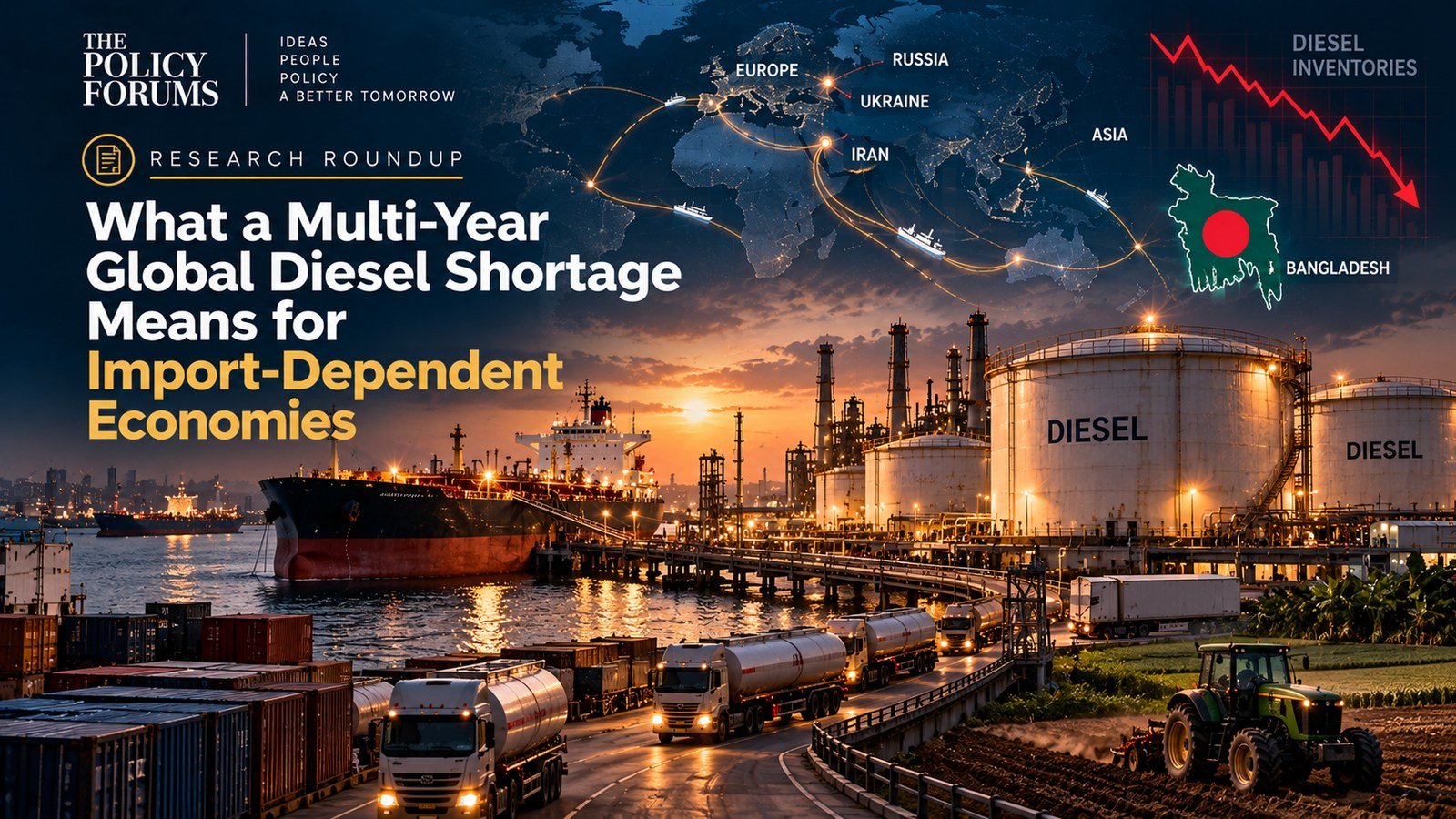
The finding: Wars in Iran and Ukraine have disrupted diesel supply chains severely enough that the US Energy Information Administration forecasts inventories will stay below the five-year low through the end of 2026 and most of 2027, The Business Standard reported. US diesel inventories hit their lowest September level since 1982; European storage sat 16% below its five-year average in July; Singapore’s distillate inventories ran below their 2025 average.
Why the shortage persists: Millions of barrels a day of diesel-producing capacity are effectively stranded in the Middle East and Russia due to the conflicts, and North American storage-for-lease rates hit a four-year high — a market signal that traders expect tight supply to persist into at least early 2027.
Why this research matters beyond the US and Europe: Diesel fuels agriculture, manufacturing, and heavy transport — sectors central to import-dependent economies like Bangladesh’s. A sustained global diesel shortage puts upward pressure on import costs at exactly the kind of economy least able to absorb it, compounding whatever domestic fuel price adjustments are already underway.
Counterargument: Some energy analysts note that refining capacity additions coming online in Asia and the Middle East over the next 18–24 months could ease the shortage faster than the EIA’s current forecast assumes, since inventory forecasts are sensitive to assumptions about new supply that haven’t yet materialized.
Policy implication: If the shortage runs through 2027 as forecast, Bangladesh’s energy import planning should treat elevated diesel costs as a multi-year baseline rather than a temporary spike, with implications for everything from agricultural input costs to industrial energy budgeting.
Recommendation: Energy policymakers should stress-test fuel subsidy and pricing frameworks against a scenario where global diesel prices remain elevated through 2027, rather than assuming a return to pre-shortage pricing in the near term.
Confidence level: Moderate. The inventory data comes from a credible government energy statistics agency, but multi-year price and supply forecasts carry inherent uncertainty, especially given how sensitive they are to the unresolved conflicts driving the shortage.
Related reading: Global diesel shortage likely to last into 2027 as storage tanks drain — The Business Standard