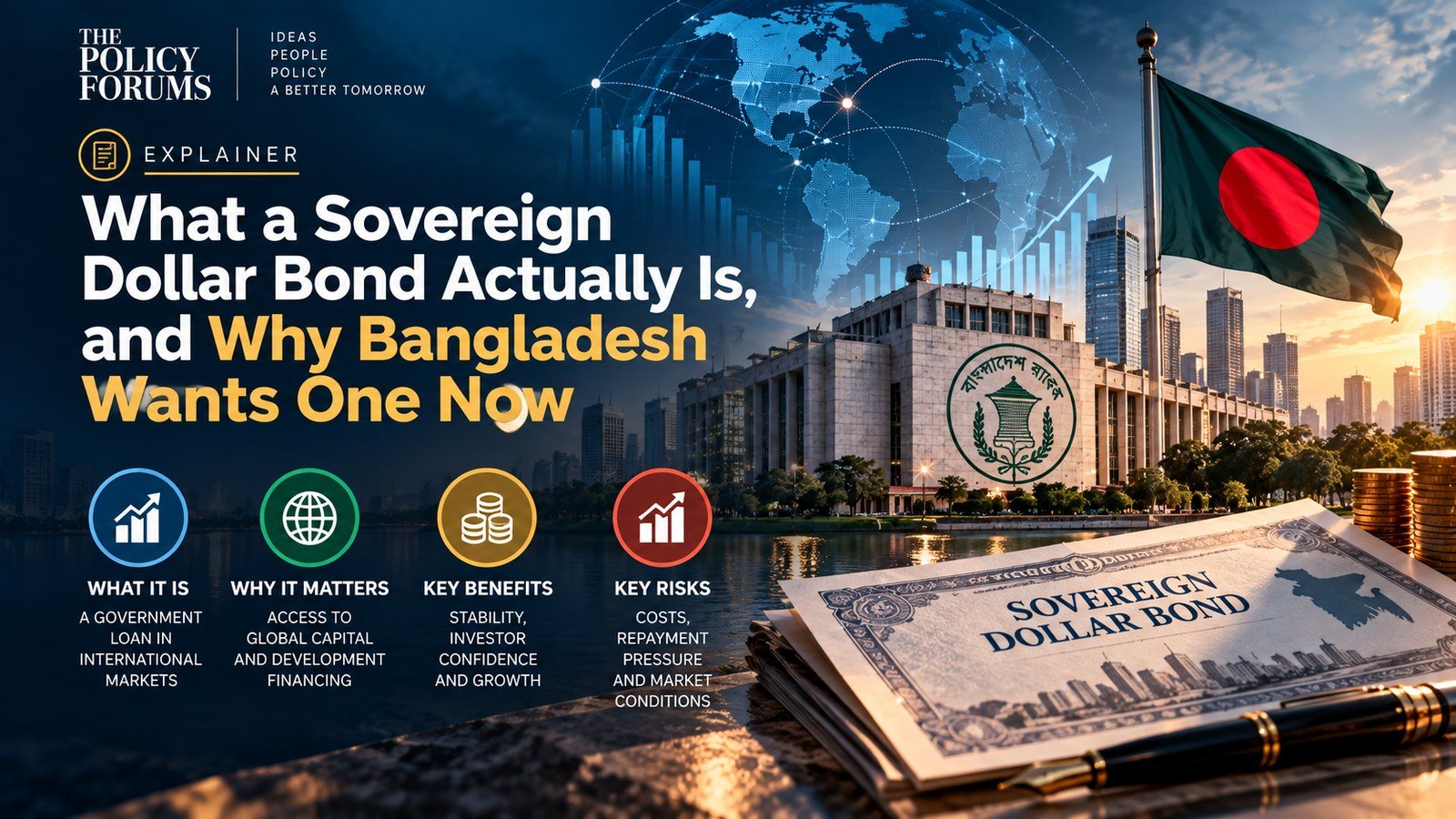
The basics: A sovereign dollar bond is simply a loan — investors buy the bond, the government receives dollars upfront, and in return it promises fixed interest payments plus repayment of the principal at maturity, all denominated in US dollars rather than local currency. Bangladesh has never issued one; its new borrowing has historically come through concessional loans from institutions like the World Bank and Asian Development Bank, or bilateral lenders such as China and Japan.
Why now: Government officials are targeting $500 million to $1 billion by December 2026, with special assistant to the prime minister Tanvir Shahriar Ghani saying investor response has been “good” so far. The bond needs to clear $500 million specifically to qualify for JP Morgan’s Emerging Markets Bond Index — inclusion in that index draws in a much larger pool of passive index-tracking investors than a smaller issuance would reach.
The approval chain: An eight-member feasibility committee formed in July 2026 has been assessing the plan, which still needs final sign-off from the Alternative Financing Committee chaired by Finance Minister Amir Khosru Mahmud Chowdhury before issuance.
Beyond dollars: Bangladesh is simultaneously scoping Panda Bonds (raised by China during the PM’s June visit), Samurai Bonds, Dim Sum Bonds, and Sukuk, plus future infrastructure and diaspora bonds — suggesting the dollar bond is the opening move in a broader shift toward market-based, multi-currency financing.
Counterargument: Critics of sovereign dollar borrowing point out that unlike concessional loans, dollar bonds carry market interest rates and full foreign-exchange risk — if the taka weakens against the dollar before repayment, the real cost of servicing the debt rises accordingly, a risk concessional lenders don’t expose borrowers to.
Why it matters: This would be Bangladesh’s first test of how international capital markets price its credit risk directly, rather than through the intermediated, often subsidized terms of multilateral and bilateral lending.
Confidence level: Moderate. The mechanics of sovereign bonds are well-established; what remains uncertain is the coupon rate Bangladesh will actually have to pay, which won’t be known until the bond is priced.
Related reading: Govt eyes first sovereign dollar bond by Dec, targets $500m-$1b — The Business Standard