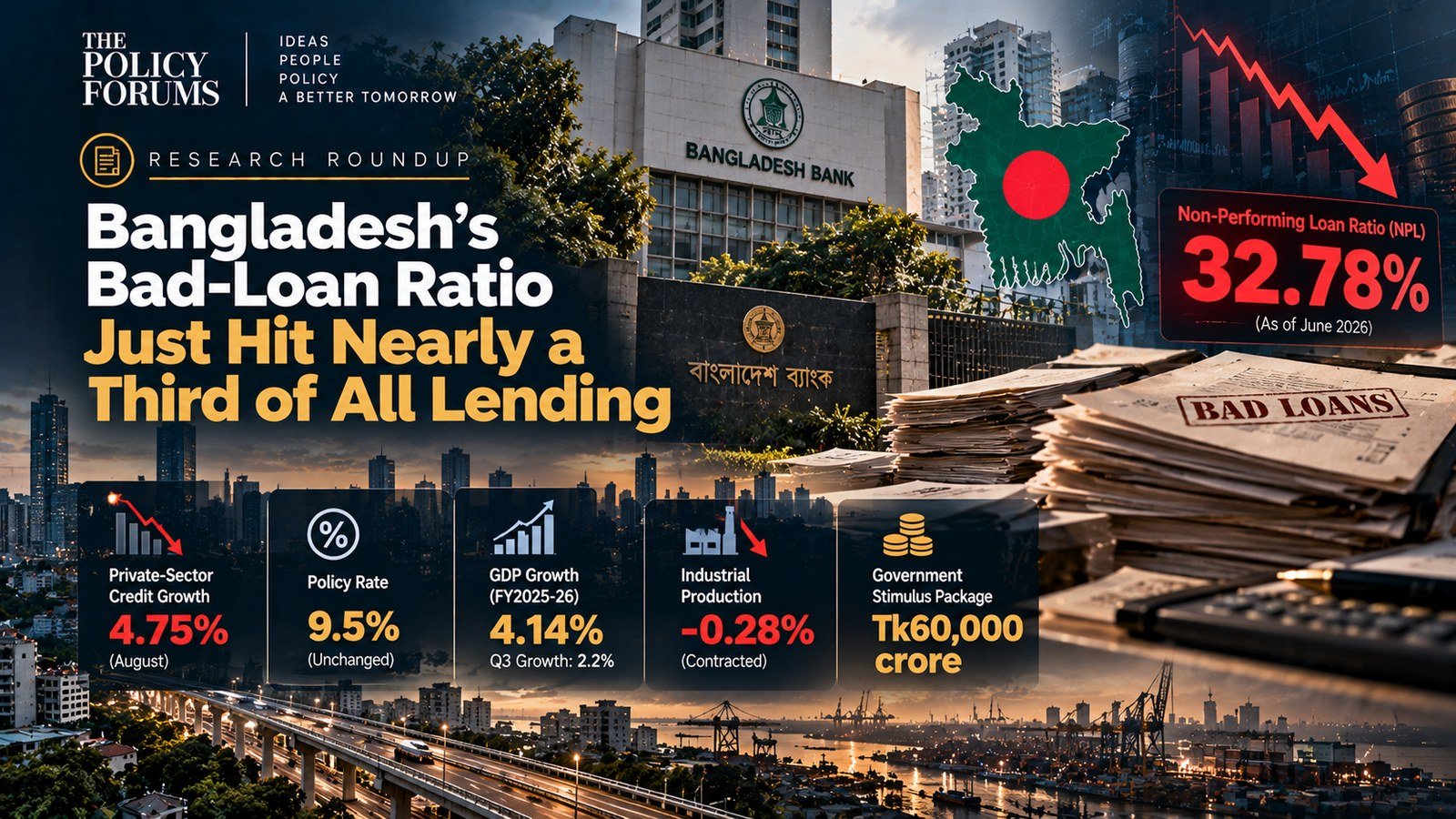
The finding: Bangladesh Bank’s Q2 FY27 monetary policy report disclosed that the non-performing loan ratio reached 32.78% as of June 2026 — meaning close to a third of all outstanding bank loans in the country are now classified as bad, even as private-sector credit growth slowed to just 4.75% in August.
Why the two numbers are connected: A rising NPL ratio alongside slowing credit growth is a classic sign of a credit crunch forming from the supply side — banks become more reluctant to extend new loans as their existing loan books deteriorate, regardless of what the policy rate is doing. The central bank held its policy rate at 9.5% in the same announcement, a decision that does little to directly address bank-level balance-sheet stress.
The broader context: This NPL data arrives alongside GDP growth estimated at just 4.14% for FY2025-26, with the third quarter printing only 2.2%, and industrial production contracting 0.28% — a combination suggesting the real economy and the banking sector are reinforcing each other’s weakness rather than one offsetting the other.
Counterargument: Some banking-sector analysts argue that a rising NPL ratio partly reflects improved loan-classification discipline and stricter provisioning rules catching up with previously under-reported bad debt, rather than purely new loan quality deterioration — meaning part of the increase could be a reporting artifact rather than a fresh crisis.
Policy implication: Whether the NPL rise is newly generated or newly disclosed, a 32.78% ratio limits how much the banking sector can support the Tk60,000 crore stimulus package the government has announced, since banks carrying this much bad debt have less capacity to extend the new credit that stimulus spending is meant to catalyze.
Recommendation: Future research should disaggregate the NPL figure by bank type (state-owned versus private) and sector, since a national average of 32.78% likely masks sharp variation that matters more for targeted policy response than the headline number alone.
Confidence level: Moderate. The NPL figure comes directly from the central bank’s own report, but whether it reflects genuine deterioration or improved disclosure cannot be determined from the published figure alone.
Related reading: BB announces monetary policy for Q2 of FY27 — The Business Standard