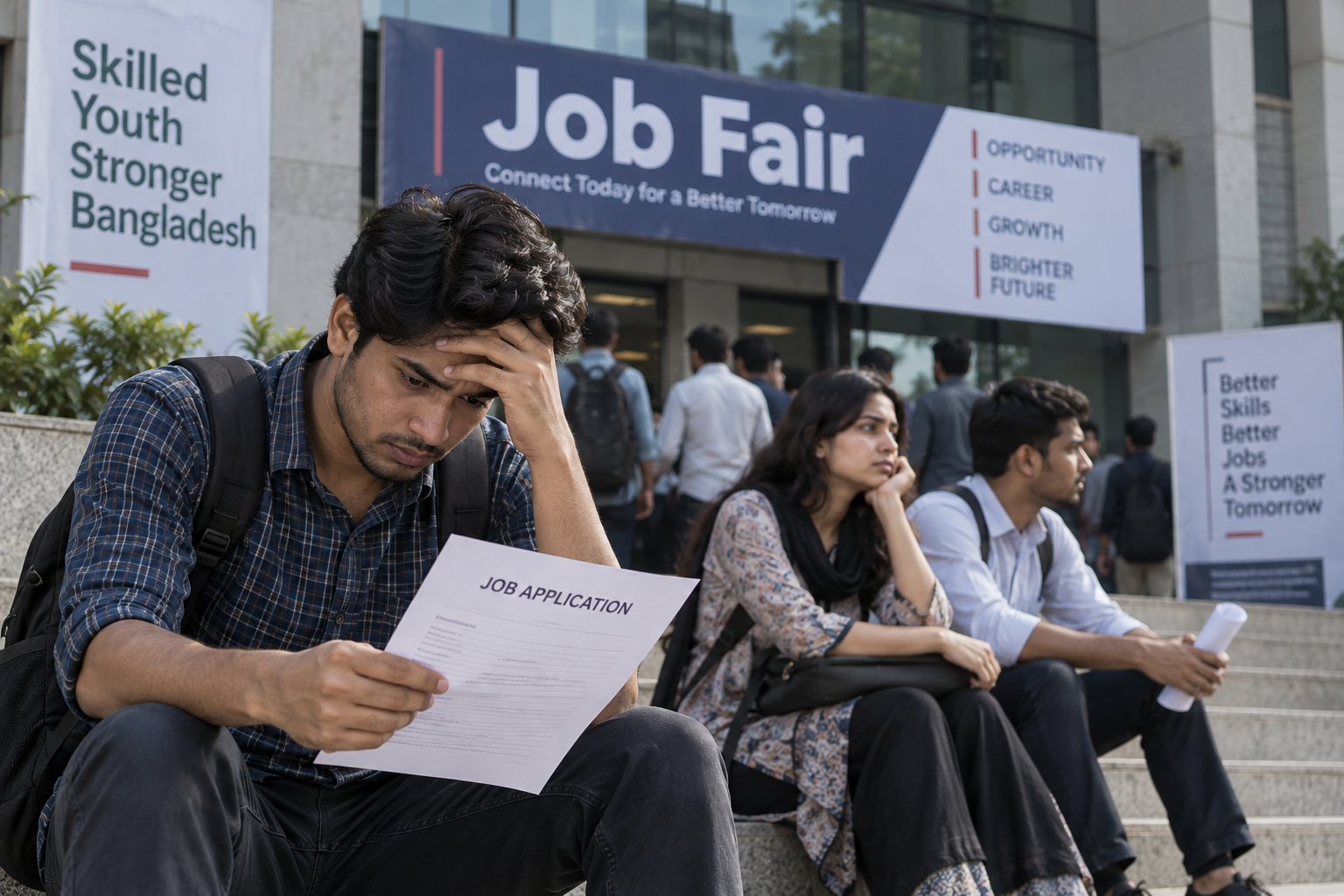
The problem: A new IMF analysis, reported by The Business Standard, found that 36% of Bangladeshi youths with postsecondary education are unemployed — more than three times the country’s overall youth jobless rate of roughly 10%. Bangladesh’s figure sits below Sri Lanka (43%) and India (42%), but far above Southeast Asian peers such as Indonesia (18%), Vietnam (16%) and Singapore (8%).
The evidence: IMF Asia and Pacific Department director Krishna Srinivasan attributed the mismatch to graduates being unable to find work that matches their qualifications, while automation and AI are displacing the entry-level technical roles — junior engineers, animators, administrative staff — that traditionally absorbed new graduates. Separately, the government has announced plans to fill 5.2 lakh vacant public-sector posts, a move that addresses headcount but not necessarily the skills mismatch driving the problem.
Counterargument: Some economists argue that filling vacant government posts and expanding public employment programmes can meaningfully absorb graduates in the short term, and that comparing Bangladesh unfavourably to Southeast Asia ignores structural differences in industrial composition — Bangladesh’s economy remains concentrated in low-skill RMG manufacturing rather than the higher-value services and electronics sectors that absorb graduates elsewhere.
Policy implications: A jobs pipeline built primarily on public-sector recruitment is not scalable, and a graduate glut alongside employer complaints of skills shortages points to a curriculum-to-labour-market disconnect rather than a simple jobs deficit.
Recommendation: Policymakers should prioritise employer-linked apprenticeship and reskilling programmes in digital and technical fields over further expansion of general higher education enrolment, and should commission a labour-market skills audit to identify where automation is displacing entry-level roles fastest.
Confidence level: Moderate. The unemployment figures come from a credible multilateral source (IMF), but the causal link to automation is one contributing factor among several, and Bangladesh-specific labour market data updates infrequently.
Related reading: For every 100 educated Bangladeshi youths entering job market, 36 remain unemployed: IMF — The Business Standard