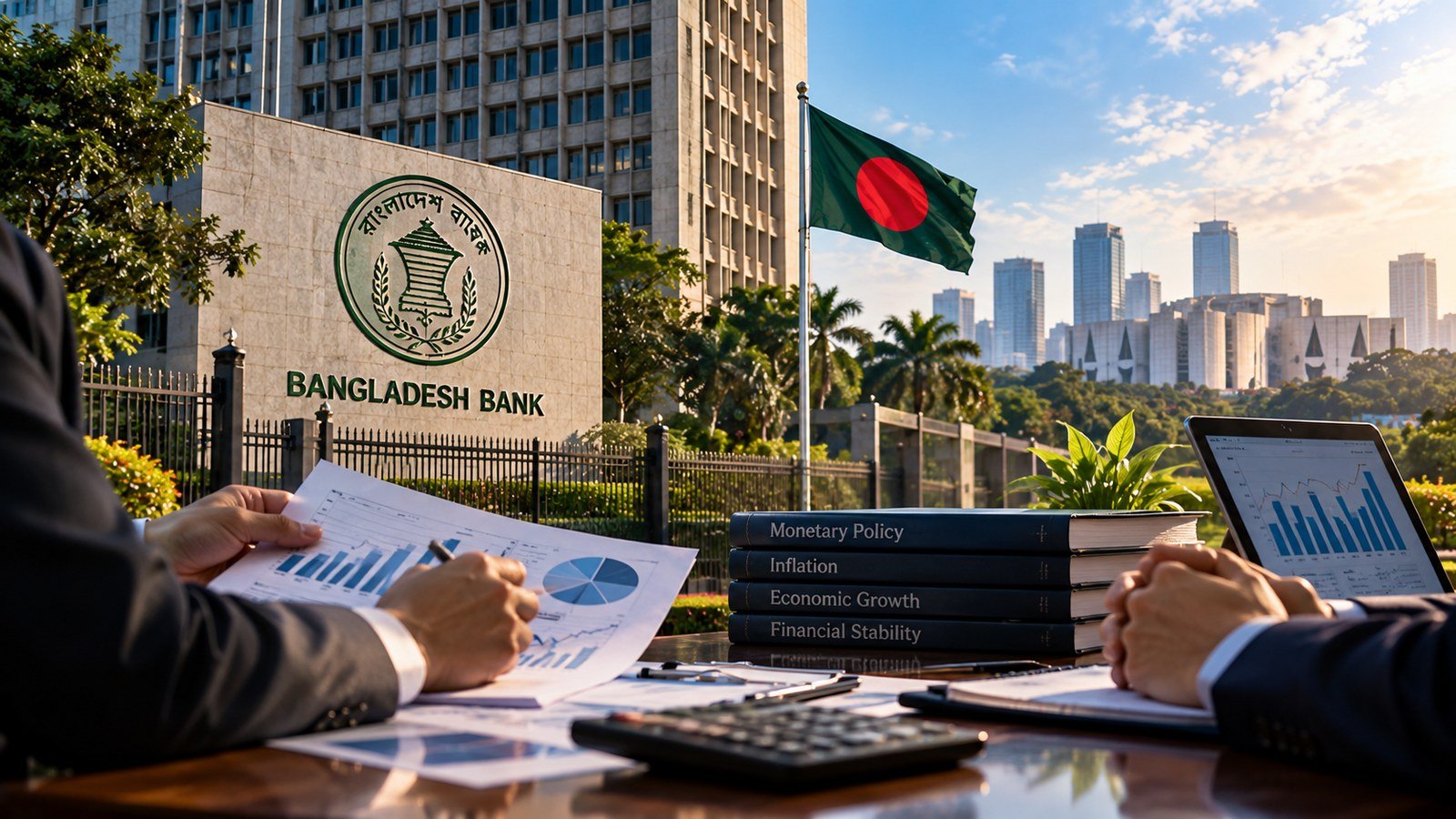
What we’re tracking: Bangladesh Bank held its policy rate unchanged at 9.5% on September 30, in the first announcement under its new quarterly monetary policy framework for Q2 of FY2027, announced by Deputy Governor Habibur Rahman.
The numbers behind the decision: Headline inflation stood at 8.26% in August 2026 (food 7.02%, non-food 9.32%), while GDP growth for FY2025-26 is estimated at just 4.14%, with a third-quarter print of only 2.2% and industrial production contracting 0.28%. The Standing Lending Facility stays at 11% and the Standing Deposit Facility at 7.5%.
What else moved: Private-sector credit growth slowed to 4.75% in August, even as the non-performing loan ratio climbed to 32.78% in June. On the external side, the balance of payments posted a $6.6 billion surplus for FY26 and remittances grew 18.90% in the first two months of FY27.
Why it matters: The central bank explicitly flagged that September’s Tk20-per-litre fuel price increase “is likely to raise transport and production costs” — acknowledging a fresh inflationary push just as it chose to hold rather than tighten further. A Tk60,000 crore stimulus package, including Tk20,000 crore earmarked for reopening closed factories, signals the central bank is now as worried about weak growth as about price pressure.
What to watch next: Whether the quarterly review cadence itself — a first for Bangladesh Bank — produces faster policy course-correction than the old twice-yearly cycle, especially if fuel-driven inflation proves stickier than the August data suggests.
Confidence level: Moderate. The figures are drawn directly from the central bank’s own announcement, but how the new quarterly framework performs in practice will only be clear after at least two or three cycles.
Related reading: BB announces monetary policy for Q2 of FY27 — The Business Standard