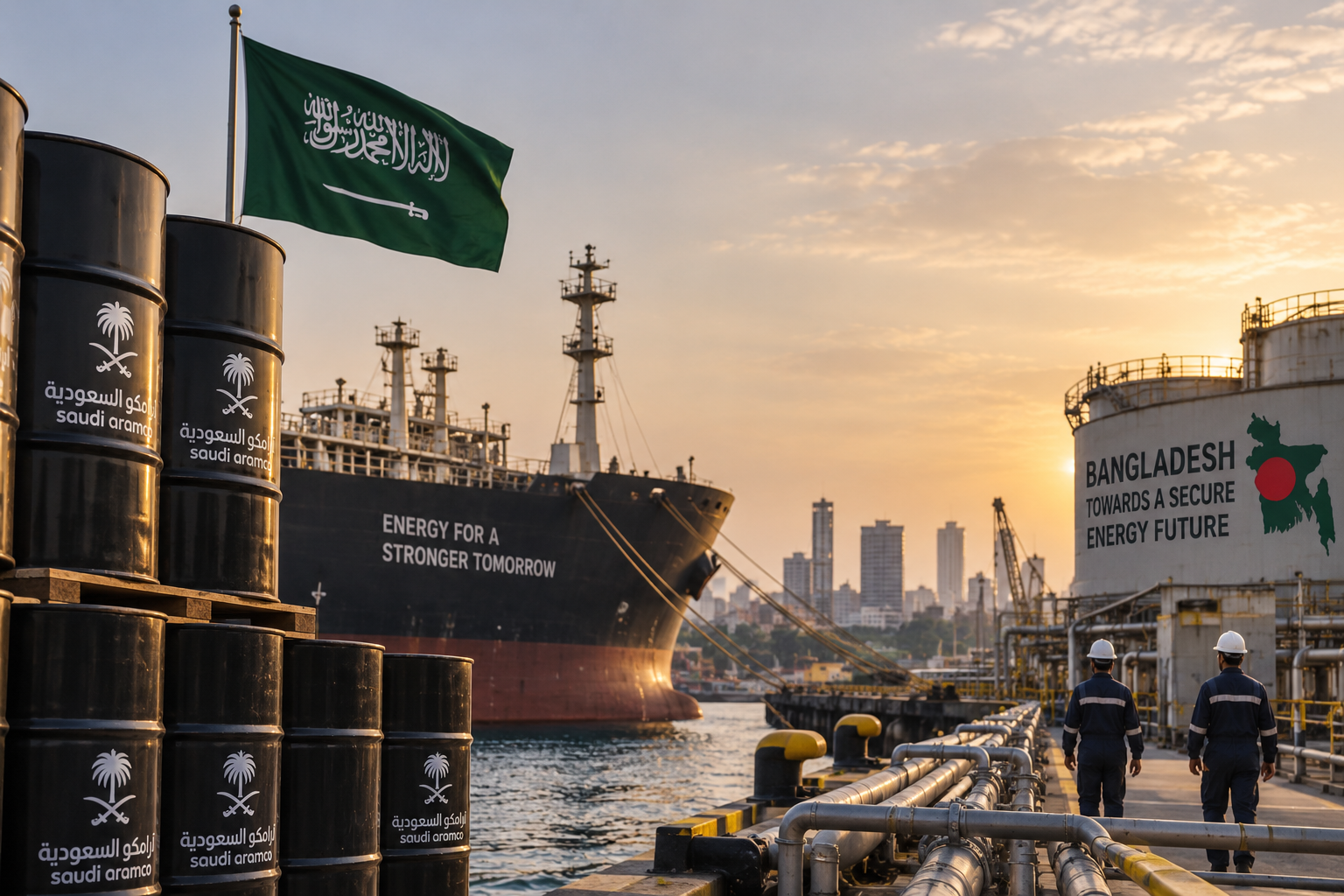
Saudi Arabia’s oil export routes are under unusual strain: the Strait of Hormuz has been effectively closed since late February, the Bab el Mandeb strait is increasingly unusable due to Houthi blockades and the seizure of Mokha port, the Suez Canal is too shallow for large tankers (forcing a 20–25 day diversion around Africa), and the East-West Pipeline — which carried 7 million barrels a day — was shut down after drone strikes near Riyadh and Madinah, The Business Standard reported. Crude has traded above $105 a barrel, and the International Energy Agency estimates 410 million barrels have been drawn from global stockpiles since the disruptions began, leaving thinner buffers against further shocks.
Why this matters for Bangladesh’s industry: Bangladesh imports the large majority of its petroleum products and a growing share of LNG for power generation and industrial gas supply, making it directly exposed to sustained Gulf price spikes through higher input costs for textiles, cement, steel and fertiliser manufacturing — industries that together anchor export earnings and domestic employment. A prolonged Gulf supply disruption compounds the fuel-price pressures already working through the domestic economy following this month’s Tk20-per-litre price hike.
Counterargument: Some energy economists argue Asian buyers, including Bangladesh, are comparatively insulated because a large share of LNG contracts are long-term and price-indexed rather than fully exposed to spot-market spikes, and that the immediate crisis is concentrated in crude-oil shipping routes rather than Bangladesh’s LNG supply chain specifically.
Policy implication: Industrial energy security planning that assumes stable Gulf shipping routes is now a riskier assumption than it was a year ago, regardless of how insulated current contracts may be.
Recommendation: Accelerate diversification of energy-import sourcing and routes already under discussion (including non-Gulf LNG suppliers), and stress-test the industrial sector’s exposure to a sustained, not just temporary, Gulf oil-price elevation as part of national energy-security planning.
Confidence level: Moderate. The Gulf supply disruption facts are well-sourced to real-time reporting; the precise transmission to Bangladesh’s industrial costs depends on contract structures not fully public.
Related reading: Saudi Arabia is running out of options to export oil. What does that mean for global energy? — The Business Standard